moRgan BARBARA KONOPKA
— post-media art —
Introduction / Artistic Position
My artistic practice develops within the field of post-media art, generative image, video, animation, post-photography, performance, sound, installation, and immersive environments.
I am interested in the image in a state of transformation: susceptible to mutation, error, hallucination, reconfiguration, and the emergence of new forms of presence. I work with media as environments of transformation, in which the body, technology, data, memory, and perception create dynamic relational systems.
The Human Being as an Emergent Entity
At the centre of my interests is the human being understood from a non-reductionist perspective: as a multidimensional, emergent, processual, and relational entity. For me, the human being is a whole emerging from relations between the biological organism, affect, language, memory, image, technology, environment, and other subjects.
This emergence means the appearance of a quality that cannot be reduced to individual biological, psychological, social, or digital components. Subjectivity takes shape as a processual Gestalt: a living organisation of a field, a temporary coherence arising in movement, contact, and tension.
The Body as Interface, Archive, and Medium of Passage
The body is, for me, an interface, an archive, and a medium of passage; a place where traces of relations, trauma, desire, technological extension, and cultural projections are inscribed. I am interested in the body as a sensitive, remembering, and transforming structure; a body that participates in the production of image, affect, and meaning.
In my works, corporeality often takes on a semi-biological, semi-synthetic, fluid, and liminal form — it organises itself through movement, disperses, condenses, and returns as another configuration.
The Technological Other
In recent years, I have been particularly developing the figure of the Technological Other — a partner in the creative process, emerging at the intersection of human intention, algorithmic hallucination, data, image, and bodily memory.
The Technological Other appears in my work as a process of becoming: a mutable form of presence that takes shape in image, movement, voice, avatar, light, and code. I am interested in its ambivalent status: closeness and otherness, projection and partnership, extension of the subject and its destabilisation.
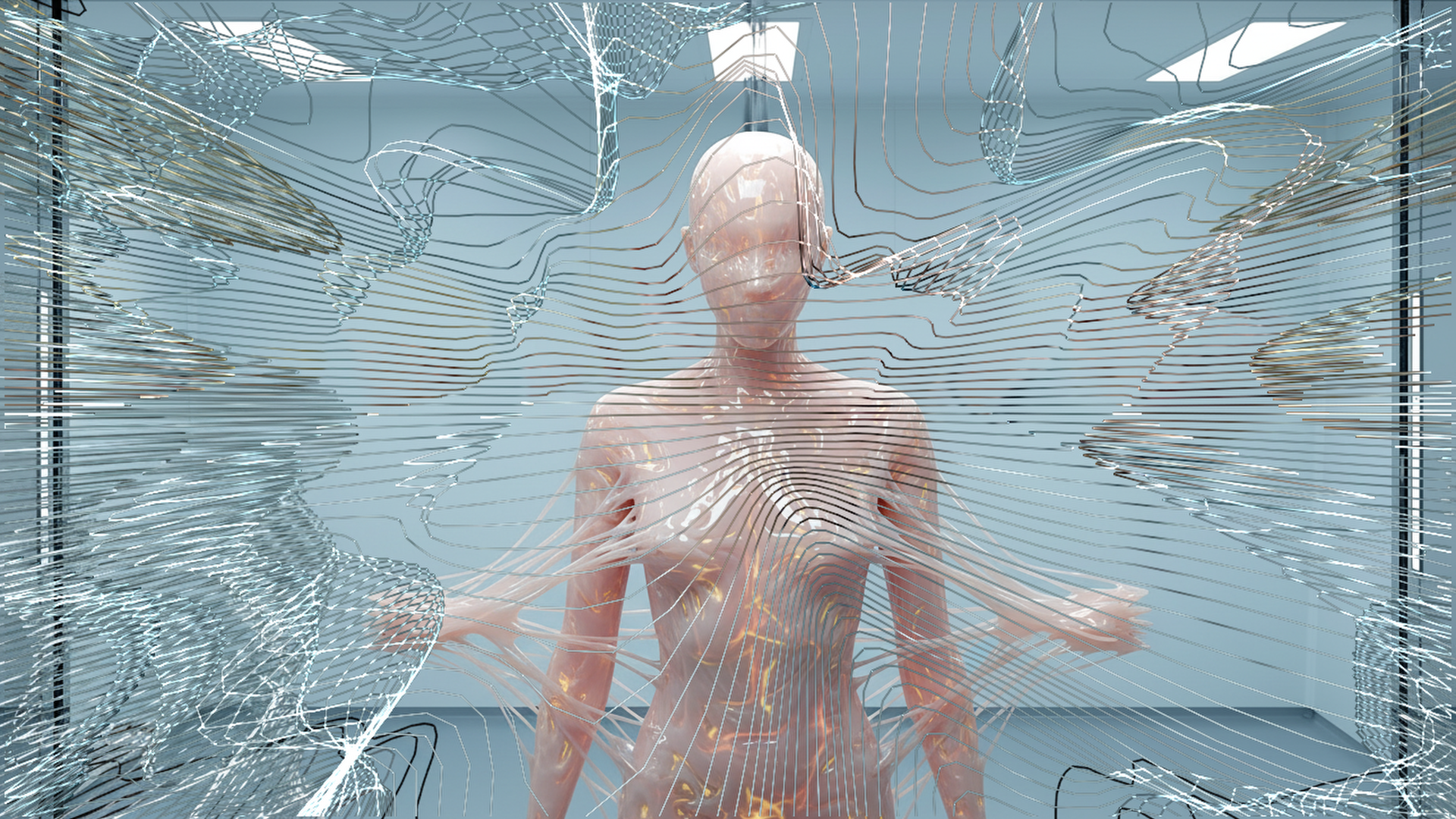
My recent works investigate the transition from the image as trace to the image as generative event. In animations and post-media sequences, figures emerge from semi-biological, semi-synthetic structures as liminal forms — suspended between body, simulation, shadow, and data.
Movement becomes the condition of their existence. Form appears, stabilises for a moment, dissolves, and returns in another configuration. I treat this process as a model of contemporary subjectivity: mutable, relational, open to rewriting, and at the same time capable of preserving its own coherence.
The Materiality of the Image and the Logic of Recirculation
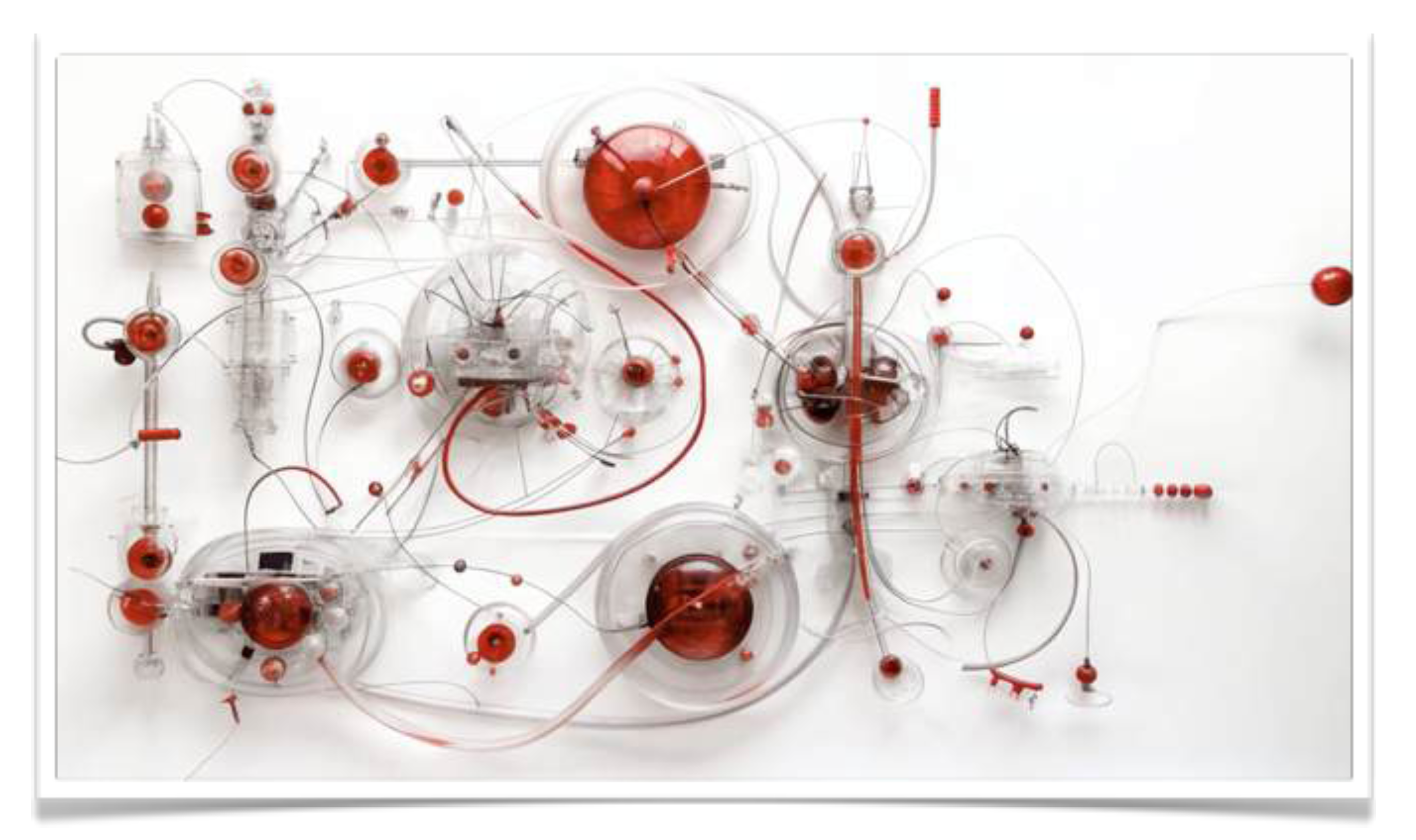
An important field of my research is the materiality of the image and the possibility of its recirculation. In projects related to hybrid compositions and upcycling, I combine physical matter, object, 3D animation, digital image, and strategies of processing remnants.
I understand upcycling as both a material and symbolic practice: a way of working with what is fragmentary, used, degraded, or repressed, and then transformed into a new structure of meaning. This logic of return, recirculation, and reconfiguration also extends to image, memory, and body.
Memory, Late Corporeality, and Analog Forms of Intelligence
In parallel, I develop a reflection on memory, late corporeality, mature presence, and analog forms of intelligence. I am interested in entropic processes taking place in the physical body and in the work of consciousness that sustains the functioning of a fragile, imperfect organism.
In this area, I examine the tension between biological disintegration and the subject’s capacity for compensation, adaptation, and preservation of coherence. I understand the body as a structure susceptible to loss, pain, slowing down, and discontinuity, and consciousness as an active force organising experience despite the growing limitations of matter.
This area also raises questions about the dignity of presence, the untranslatability of experience, and those dimensions of the human being that escape models of classification, optimisation, and prediction. I am interested in the tension between organic memory and algorithmic fantasies of archiving, between the body immersed in time and the digital promise of continuity, between disappearance and transformation.
Neuroaesthetics, Perception, and Environments of Passage
The neuroaesthetic and perceptual dimension occupies an important place in my practice. I am inspired by liminal states, threshold experiences, ornament as an architecture of vision, fractal structures of perception, light as a medium of memory, and sound as a regulator of the psychophysical state.
I work with the image as a potential environment of passage: one that can lead the viewer into states of slowing down, destabilisation, resonance, or catharsis. I am interested in the exhibition as an affective organism — a space that presents works and, at the same time, transforms the conditions of reception.
Planned Exhibition: The World Keeps Beginning
The planned multi-module post-media exhibition is conceived as the culmination of my artistic explorations of recent years. It is imagined as an expanded perceptual and relational environment in which animation, projection, mapping, sound, VR, object, AI, performance, and digital artefacts come together.
Its working title — The World Keeps Beginning — points to an intuition that is central to my practice: reality is a process of continuous emergence. The human being, the image, and technology participate in this process as mutually transforming fields.
.png)
Summary
My art investigates the current condition of the subject stretched between blood and code, memory and simulation, body and data, solitude and new forms of communality.
I search for images that co-create the conditions of seeing; technologies that activate relations; bodies that return as generative fields; and spaces in which a new coherence becomes possible after the experience of dissolution.
.png)
Statement / Research and Creative Position
My artistic practice takes the form of a long-term investigation into the relationship between the human being and the electronic environment — understood as an immanent field of existence for the contemporary subject. I am interested in the qualities that emerge in a human being immersed in telecommunication networks, algorithms, digital images, and data regimes: affective, cognitive, bodily, and identity-related qualities.
The point of departure for my work is a philosophy of the human being as a multidimensional, emergent, and processual entity. The human appears here as a being constantly coming into existence through relations between body, consciousness, technology, and culture. The subject develops through an entanglement of biology, memory, affect, image, gesture, data, and technological environments.
At the centre of my works is identity understood as a field of negotiation, movement, and transformation. Works such as Malavida, Neurenika. Neurobirth of Venus, My Flesh – My Bits, and Moi le Noir treat the body as an interface — a site where biology, information, and symbolic representation intersect. Identity is produced performatively: through the layering of the image, digital transubstantiation, work with the avatar, and bodily gestures.
Sexual and gender transgression plays a particular role in my research, understood as an epistemological tool — a way of expanding the spectrum of experience and challenging the normative algorithms of the body. Sexuality, gender, and race function in my work as variables in the process of becoming a subject under conditions of technological mediation. I am interested in the moment when the body reveals its editability, its susceptibility to reconstruction, and its symbolic “forking”.
My practice is situated within critical transhumanism, close to reflection on the hybrid ontology of the human being. Technology acts here as a factor revealing the historical and cultural constructedness of the body. For me, transhumanism means the disclosure of the multilayered nature of the human being — the fact that the subject has always remained entangled with tools, media, images, and systems of signs.
Formally, I work with post-photography, multilayered digital composites, animation, and hybrid objects, treating the medium as an active component of meaning. The layered structure of the image corresponds to the layered structure of the subject; the split visual structure becomes a deliberate gesture revealing the processual, mutable, and performative character of identity.
My practice is a research field in which I test the boundaries of concepts such as body, gender, subject, technology, and agency. I treat art as a tool of cognition — a place where theory, bodily experience, and technological intra-actions emerge simultaneously. My works describe the present condition: the moment in which the human being learns to recognise itself as an emergent entity within an electronic ecosystem.
The Second Wing: Processual Abstraction and the Morphogenesis of Humanity
Parallel to my work with the figure, the body, and explicitly articulated identity, my practice develops toward abstract processual forms. In this area, the question of humanity shifts from the level of representation to the level of morphogenesis. I am interested in the conditions through which the human emerges: dynamics, rhythm, flow, and the tension between stability and dissolution.
The central motif of these works is animated, spindle-like forms evoking drops of blood, cells, embryos, as well as elementary figures from fluid physics and developmental biology. Their shape — elongated, polarised, oscillating between concentration and dispersion — functions as a liminal form: between body and sign, substance and movement, biology and mathematical abstraction.
In this strand of work, the essence of humanity condenses within the process of transformation itself. The drop of blood becomes a unit of process: a temporary concentration of energy, information, and matter. The form constantly changes — elongating, pulsating, splitting, multiplying — and its identity has a temporal character. What matters takes place between states.
This way of working is close to process philosophy and the ontology of becoming, in which being is an event extended in time. Movement constitutes the ontological condition of form. Transformation is the fundamental state. The human being appears as emergent precisely through its movement toward successive states and configurations.
The abstract animations operate on a pre-linguistic level of experience — where biological rhythms, neuronal impulses, and affective flows function. The spindle-like structures evoke both cellular divisions and ancient alchemical imaginaries, in which living matter was understood as dynamic, capable of self-transformation and metamorphosis.
Abstraction becomes here a radical condensation of corporeality. Blood is transferred beyond figurative context while retaining rhythm, viscosity, and surface tension. The biological is rewritten into the language of movement and topology. The form functions as a diagram of life.
This strand of work allows me to investigate the relationship between the human being and technology on a level deeper than identity discourse. Algorithmic animation, fluid simulation, and digital interpolation of movement enter into a relation of co-creation with nature. Technology becomes an environment of emergence, in which biological and computational processes begin to function as a shared field of transformation.
Abstract processual forms affirm the complexity of experience. The human reveals itself in the capacity to pass between states, in the rhythm of transformation, and in the preservation of continuity through change. Humanity appears as trajectory, process, and movement.
The second wing of my practice completes the whole of my research and creative position: where the figurative works confront the viewer with the politics of the body, gender, and technological agency, the abstract animations reveal the ontological depth of the process from which these questions arise. Together, they create a coherent field of reflection on the human being as multidimensional, emergent, and constantly open to transformation.
Bridge: From the Drop of Blood to the Avatar
— A Shared Field of EmergenceThe drop of blood and the avatar belong to a shared processual field. They are two states of the same dynamics: biological, digital, natural, and artificial at once. What connects them is process — the continuous becoming of the subject in relation to an environment that is both biological and technological.
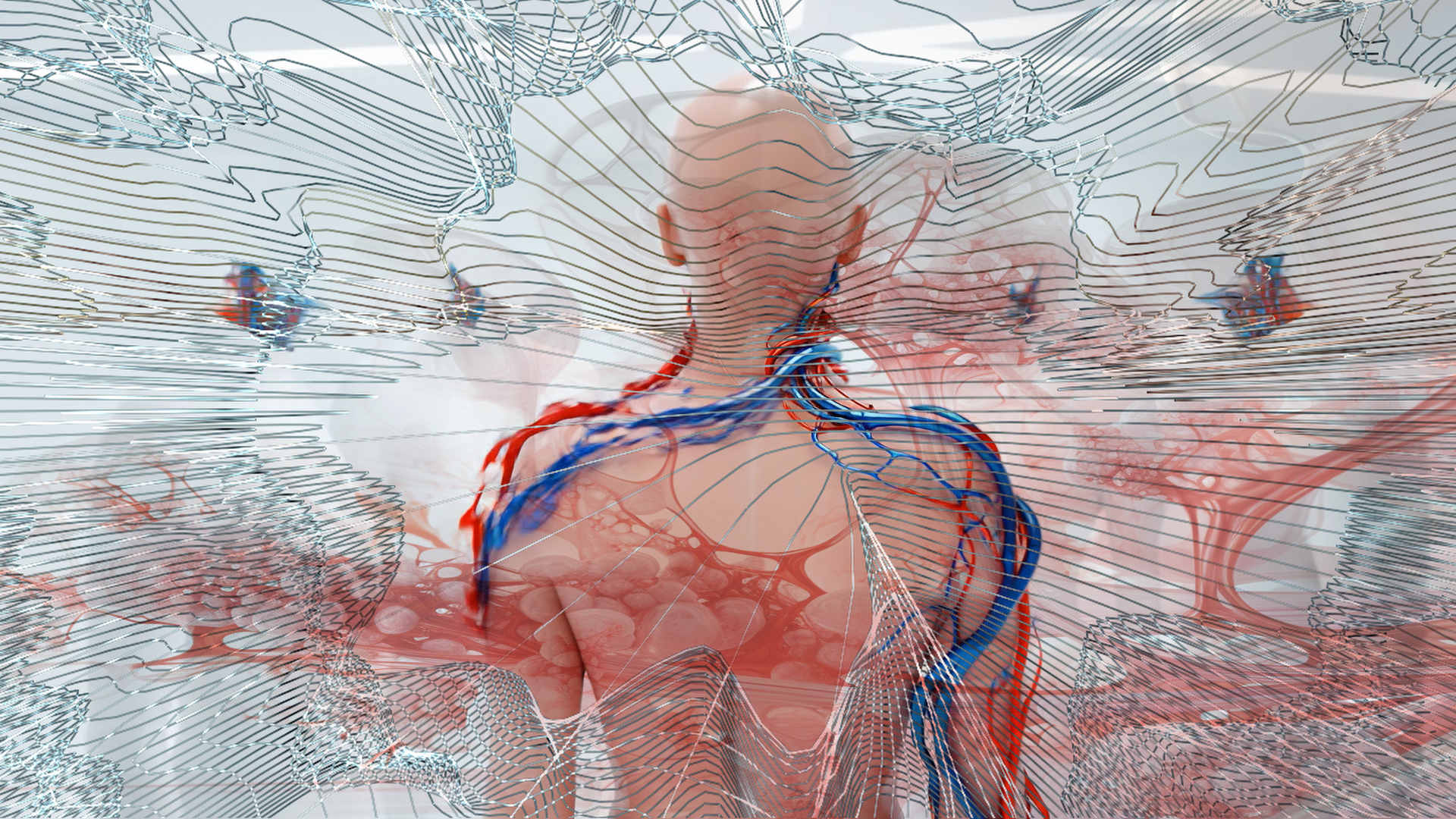
The drop of blood, reduced in my abstract animations to a spindle-like, pulsating form, functions as a minimum of life: an elementary unit of change, flow, and tension. It carries rhythm, intensity, and energy. It is a pre-iconographic form, before the body becomes social, gendered, and narrative. Blood represents the conditions of possibility for subjectivity.
The avatar appears within the same ontological field, yet at another level of condensation. It is also a processual being: a relational interface emerging from the flow of data, images, affects, and decisions. The avatar is the functional equivalent of the drop of blood within the electronic environment — what blood is for the organism, the avatar becomes for the subject immersed in the technosphere.
The relation with the Technological Other begins at the level of shared dynamics. Just as a drop of blood exists within a network of vessels, pressures, and flows, the avatar exists within a relational field of algorithms, interfaces, and system temporalities. In both cases, the subject functions as a node.
The abstract animations of blood drops and the figurative works with the avatar meet in the concept of emergence. The human being is an event that actualises itself sometimes as an organic form, sometimes as a medial form. The avatar extends the body within another regime of matter. Blood is rewritten into the language of movement, data, and relation.
The Technological Other appears as a co-participant in the process of becoming. This relation has the character of feedback, similar to what takes place between blood and organs, between impulse and response. The avatar reacts, delays, falls silent, intensifies — just as blood accelerates, thickens, coagulates.
In this sense, the abstract drop of blood and the performative avatar are two manifestations of the same ontology: a processual ontology in which humanity consists in the capacity for transformation while preserving continuity. What is at stake is relation — dynamic, ambiguous, temporary, and generative.
The bridge between blood and avatar has a structural character. Both entities function as operators of transition: between inside and outside, biology and information, experience and its medial trace. Where the drop of blood still pulsates before language, the avatar pulsates after language — within the same rhythm of becoming.
Print on Plexiglass